
 Sophie Parker
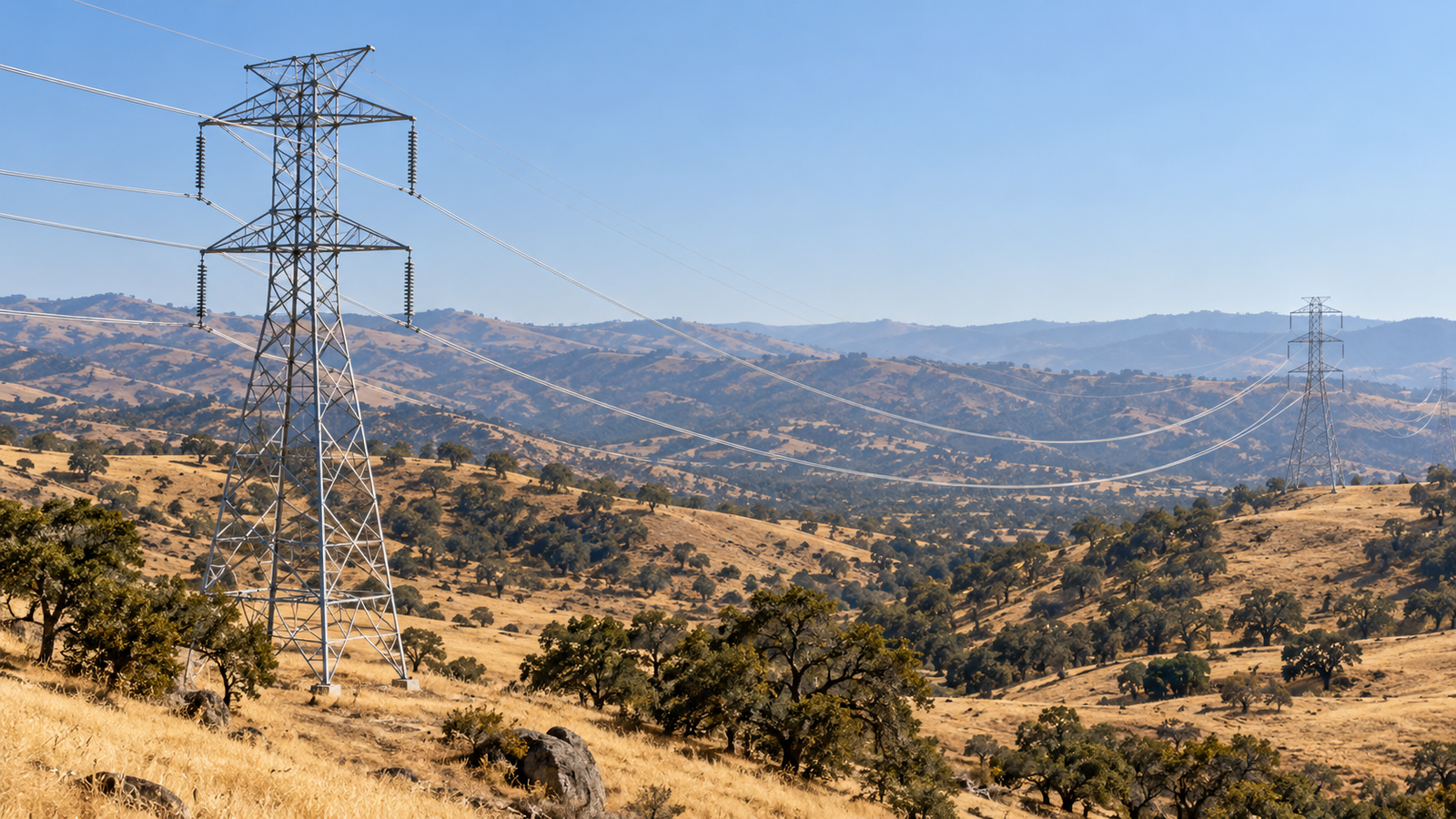
Picture a transmission line on the hottest afternoon of the year. Temperatures have hit 40°C, there’s no breeze to speak of, and air conditioners across the valley are working overtime. Current pours through the wires, the metal heats up, and the line quietly stretches. A few feet lower than it hung in the morning, it now passes close to a dry oak that nobody thought was a problem.
That slow droop is called sag, and most people never notice it. Utility engineers do. In wildfire country, the gap between a sagging conductor and whatever sits below it can be the difference between an ordinary summer day and an ignition.
For years, sag was treated as a capacity limit: a number that capped how much power a line could carry. Today it deserves a second label. With heat waves stretching on for longer and power demand rising year after year, low-sag advanced conductors are no longer a specialty upgrade. They are fast becoming a core tool in wildfire and extreme-heat planning.
What is conductor sag, and why does heat make it worse?
Conductor sag is the vertical distance between the point where a wire attaches to a tower and the lowest point of the curve it makes between two structures. Every overhead line sags a little. The question is how much, and when.
Metal expands as it warms. A line heats up from three main sources:
- Electrical load. More current means more resistive heating inside the wire.
- Sunlight. Solar radiation adds heat, especially on clear summer days.
- Hot, still air. High ambient temperature and low wind make it hard for the conductor to shed heat.
On a peak summer day, all three hit at once. The conductor lengthens, and because the towers don’t move, the extra length shows up as a deeper droop toward the ground, trees, and other wires.
The traditional workhorse of the grid, ACSR (aluminum conductor steel reinforced), was designed more than a century ago. Its aluminum strands and steel core both expand with heat, and as the line runs hotter, more of the load shifts to the steel core. That works fine within its rated limits. But push an ACSR line toward its thermal ceiling during a heat wave and sag grows fast. In practice, the maximum sag allowed by clearance rules, not the wire’s ability to conduct, is often what limits how much power a line can safely carry.
Why conductor sag is a wildfire risk
A sagging line is a line with less margin. When clearance shrinks, three things that start fires become more likely.
- Vegetation contact. Tree-trimming distances are planned around the height a line is expected to hang. When a span carrying heavy current on a scorching day droops below that height, a limb that looked far enough away in April can end up close enough for electricity to jump the gap by late summer. In PG&E’s 2026–2028 Wildfire Mitigation Plan, contact with trees and plants ranks among the leading causes of ignition, sharing top billing with equipment failure.
- Wire-to-wire contact (line slap). Longer, looser spans swing more in wind. When two phases touch, they spark. PG&E tracks this as its own category of ignition, commonly called line slap. Lines that sag deeply during heat and then face gusty fire-weather winds are a textbook setup for it.
- Clearance violations to the ground and structures. Sag that exceeds design limits can bring conductors too close to roads, buildings, other circuits or terrain. Utilities call these sag or clearance violations, and fixing them often means taller towers, new structures, or permanently lowering the line’s rating.
The timing makes it worse. The conditions that stretch lines the most — extreme heat, dry fuels and heavy demand — overlap with the season when vegetation is most flammable. In other words, sag peaks right when an ignition would do the most damage.
Extreme heat and load growth are pushing lines harder
Two trends are squeezing the same margin from opposite directions.
Hotter summers. According to PG&E, California has never had a hotter summer than 2024, when temperatures averaged 77.3°F. That record came just a year after a severe heat wave in July 2023. The utility calls this cycle “weather whiplash”: years of drought give way to heavy storms that fuel new plant growth, and then intense heat bakes that growth into dry fuel. Today, over 50% of the territory PG&E serves is classified as high fire risk.
Much higher demand. At the same time, utilities are planning for a surge in large loads, driven mostly by data centers. A Wood Mackenzie study reported by Solar Power World found U.S. investor-owned utilities have 116 GW of large-load capacity committed or under construction, equal to about 15.5% of current U.S. peak demand. About 60 GW of that is expected online by 2030.
Put those together and you get the planning problem in one sentence: lines will carry more current, on hotter days, in drier landscapes. More current means more heat in the wire. More heat means more sag. And building brand-new transmission corridors takes many years of permitting and construction that most regions don’t have.
What are advanced conductors?
Advanced conductors are overhead wires built to carry more current at higher temperatures while sagging less than conventional ACSR. Most do it by replacing the steel core with a lighter, stronger material that barely expands with heat, such as a carbon-fiber composite or an aluminum-matrix composite.
The core is the key. In a composite-core conductor, the core holds its length as the line heats up, so the span keeps its shape. Many designs also use trapezoidal aluminum strands that pack more conducting metal into the same outer diameter. The result is a wire that can often be strung on existing towers yet run hotter and carry far more power, without dropping closer to the ground.
Here’s how the main families compare in general terms:
| Conductor type | Core material | Typical max continuous temp (approx.) | Sag at high temperature |
|---|---|---|---|
| ACSR (conventional) | Steel | 75–100°C | Grows quickly near thermal limit |
| ACSS | Annealed aluminum over steel | Up to ~250°C | Lower than ACSR, but steel still expands |
| Composite core (e.g., ACCC) | Carbon/glass fiber composite | ~180°C | Very low; core barely expands |
| Aluminum-matrix composite (e.g., ACCR) | Ceramic fibers in aluminum | ~210°C | Low |
Temperatures are typical published ranges; actual ratings depend on the specific product and design. Always use manufacturer datasheets for engineering work.
Adoption is already real. An Idaho National Laboratory scan of more than 40 transmission utilities found that over 70% have deployed advanced conductors somewhere. It also estimated about 125,000 miles of existing U.S. transmission lines could still benefit from them.
Case study: how SCE fixed sag violations without rebuilding
Southern California Edison’s Big Creek corridor shows what reconductoring can do. The line carries power from SCE’s Big Creek hydroelectric project in the Sierra Nevada foothills to Los Angeles along a 241-mile route. Parts of it date back to 1912–1913, and it was upgraded to 220 kV in the 1920s.
By 2018, SCE needed to rebuild 137 miles of the line. The original plan was to restring with conventional ACSR Dove conductor, at an estimated $135 million. Instead, SCE chose ACCC Dove: a composite-core conductor with the same diameter as the old wire. According to the CTC Global case study, the swap let SCE keep its existing towers and avoid much of the permitting and environmental review a rebuild would have needed.
| Metric | Reported result |
|---|---|
| Line length | 137.2 circuit miles, 230 kV single circuit |
| Line rating | 936 A → 1,520 A |
| Sag | All sag violations mitigated; 39% sag savings |
| Line losses | Reduced by 30% |
| Construction time | About 18 months vs. an estimated 48 months |
| Project cost | $87 million reduction |
| Tower replacement avoided | About $50,000 per tower |
Figures as reported by the conductor manufacturer.
The safety takeaway is simple. SCE didn’t just gain capacity. It removed every sag violation on the corridor while raising the rating by more than 60%. More power and more clearance usually pull in opposite directions; low-sag conductors let a utility have both.
Where advanced conductors fit in a wildfire mitigation plan
Modern wildfire plans work in layers. PG&E’s 2026–2028 plan frames it as interrupting a sequence: equipment failure or contact, then a spark, then an ignition, then a catastrophic fire. Each layer tries to break that chain at a different point.
The main tools today look like this:
- Undergrounding. PG&E says it removes nearly all wildfire risk from a line once complete, and targets more than 1,000 miles over the plan period. It is also the slowest and most expensive option.
- Overhead hardening. Where burying lines isn’t feasible, utilities install sturdier poles and insulated (covered) wire. PG&E estimates this approach lowers the chance of ignition by close to two-thirds.
- Operational settings. Enhanced Powerline Safety Settings (EPSS) that trip a line in a fraction of a second when a fault is detected, and Public Safety Power Shutoffs (PSPS) as a last resort.
- Vegetation management and inspections. Clearing, pruning and risk-ranked patrols.
- Monitoring. Weather stations, AI-equipped cameras and grid sensors.
Advanced conductors also fall under the hardening category, yet the risk they address isn’t quite the same one that covered wire targets. Covered conductor insulates the wire so a brief contact is less likely to spark. Low-sag conductor keeps the wire from getting close to things in the first place, even at peak heat and load. On a long transmission span, where undergrounding is rarely realistic, that clearance is often the most practical protection available.
They also support the other layers. A line that holds its clearance needs fewer emergency trims during heat waves. A line with spare thermal headroom is less likely to be pushed to its limit when a neighboring circuit is shut off for PSPS and load shifts onto it. And because reconductoring reuses existing rights-of-way, it can move faster than a rebuild, which matters when risk is growing every fire season.
Pairing advanced conductors with grid-enhancing technologies
Advanced conductors change what the line is made of. Grid-enhancing technologies (GETs) change how much you know about it and how you run it. Used together, they turn sag from a guess into something you can measure and manage.
Dynamic line rating (DLR) is the most relevant GET for sag. Traditional ratings assume conservative, fixed weather, such as hot air and little wind. DLR uses sensors and forecasts to estimate a line’s real thermal state in real time. Idaho National Laboratory, which has nearly two decades of DLR research behind it, describes uses that include emergency relief during peak load and day-ahead forecasts to plan which generators to run. INL also points to “concurrent cooling”: the same wind that boosts wind-farm output also cools nearby lines.
From a safety point of view, DLR works in both directions. On a cool, breezy day, it can unlock extra capacity. On a still, scorching afternoon, it can show operators that a line is running hotter and sagging lower than its static rating assumes. That second signal is the one wildfire planners care about most.
Monitoring sensors add another layer. Take PG&E’s Gridscope units: these pole-mounted sensors pick up vibration, sound, heat signatures, and visual cues. The utility reports that on at least 10 occasions, they caught a developing hazard before it could lead to an outage or a fire.
A practical way to think about the combination:
- Advanced conductor: keeps sag low by design, every day, for decades.
- DLR and sensors: confirm actual conductor temperature and clearance during the worst conditions.
- Operations: use that data to decide when to shift load, de-rate, or send crews.
How to build sag into wildfire and extreme-heat planning
For utilities and grid planners, treating sag as a safety metric comes down to a few concrete steps:
- Map sag risk, not just fire risk. Overlay high fire-threat areas with spans that run close to their clearance limits at peak temperature and load. The overlap is where reconductoring buys the most safety.
- Plan for tomorrow’s heat, not yesterday’s. Rating assumptions based on decades-old weather may understate today’s summers. Stress-test critical spans against recent record heat.
- Model future load on each corridor. A line that’s fine today may be pushed to its thermal limit by a new data center or electrification load in a few years.
- Check existing clearance and sag violations. These are often the fastest wins, since a same-diameter, low-sag conductor can fix them without new towers.
- Compare reconductoring against rebuilds and undergrounding. Count avoided structure work, permitting time and line-loss savings, not just the price of the wire.
- Coordinate with vegetation crews. Clearance zones should reflect the line’s maximum operating sag, not its typical sag.
- Add monitoring where it counts. Put DLR or sag sensors on the highest-risk spans to verify real-world performance during heat waves.
- Train crews early. Composite-core conductors need specific hardware and installation practices; plan for that before construction starts.
The limits and trade-offs
Advanced conductors are not a silver bullet, and it’s worth being honest about where they fall short.
- They don’t stop every ignition. A bare conductor is still bare. Falling trees, flying debris, animals and failing hardware can all cause faults regardless of sag. Low-sag conductor reduces one risk; it doesn’t replace undergrounding, covered conductor or operational safeguards in the highest-risk areas.
- Higher capacity can mean higher operating temperature. If a utility uses the new headroom to run the line much hotter, it needs to confirm that connectors, splices and other hardware are rated for it. Hot, aging fittings are their own failure point.
- Up-front cost is higher. The wire itself usually costs more per mile than ACSR. The savings come from avoided towers, faster permitting and lower losses, so the business case depends on the project.
- Handling and installation differ. Composite cores need the right tools, hardware and crew training. Shortcuts during stringing can damage the core.
- Data still matters. A low-sag line on outdated weather assumptions is still being planned with blind spots. Pairing with monitoring closes that gap.
Conclusion: treat sag as a safety metric
For most of the grid’s history, sag was an engineering footnote, a number that set a line’s rating and lived in a spreadsheet. That view no longer fits. Hotter summers, drier landscapes and fast-rising demand from data centers and electrification are all pushing overhead lines toward their limits at the same time.
Advanced conductors give utilities a way to add capacity without giving up clearance. The SCE Big Creek project showed it can be done on century-old corridors, on existing towers, in a fraction of the time a rebuild would take. Paired with dynamic line rating, smarter monitoring and the layered defenses already in wildfire mitigation plans, low-sag conductors help keep lines where they belong: well above the trees, even on the hottest day of the year.
The bottom line for planners is straightforward. If a line is in fire country and running near its sag limit, its conductor is part of the wildfire plan, whether the plan says so or not.


 Madonna Smith

 Anica Oaks
 Aparna Ganguly