
 Patrick Tennyson
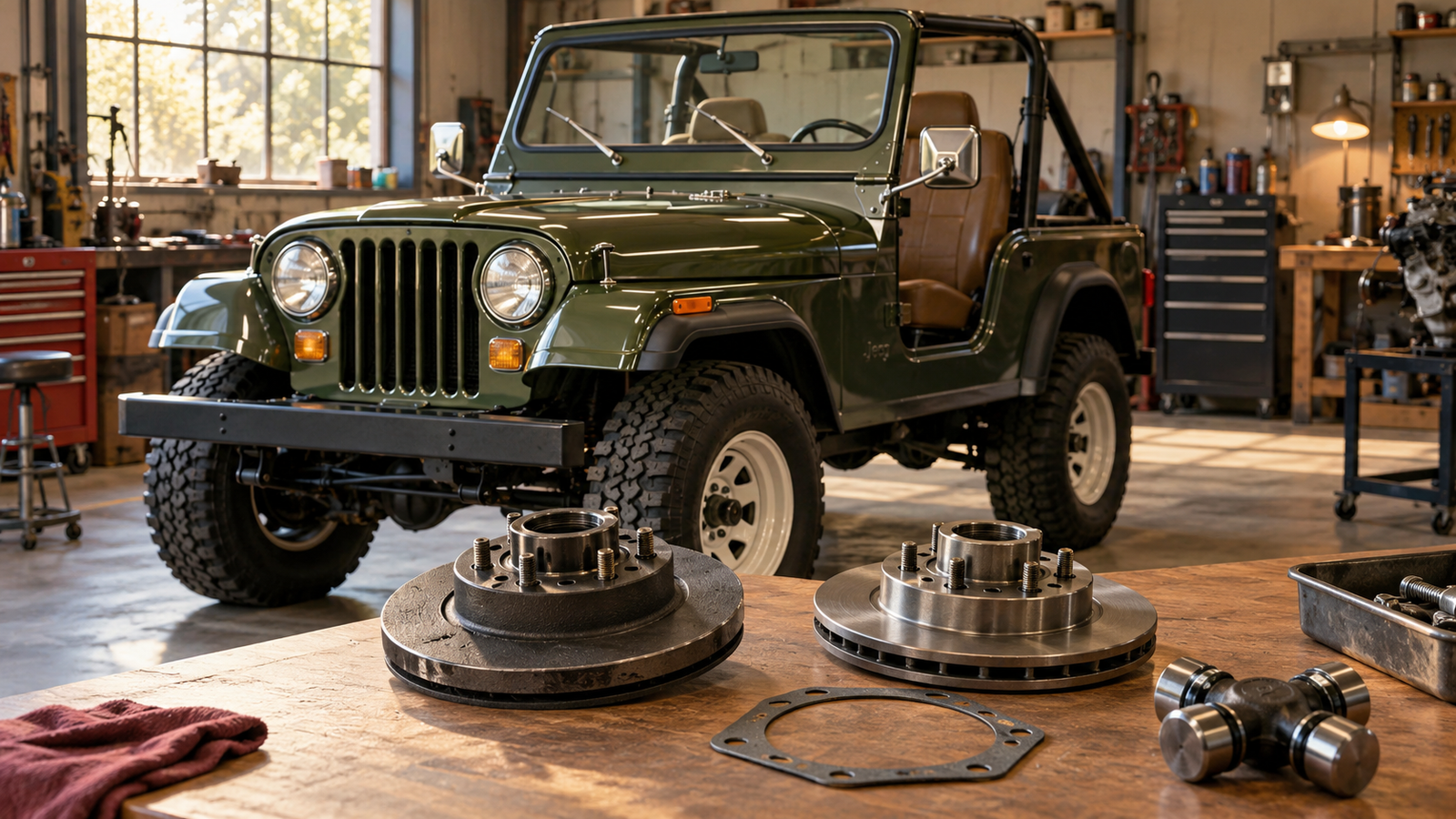
On paper, every CJ-7 looks like the same truck: 93.5-inch wheelbase, square door openings, removable top. Under the skin, though, a 1977 and a 1985 share surprisingly few mechanical parts. AMC kept tinkering year after year, sometimes even partway through a model year, and parts catalogs follow those changes closely.
That is why the first question at any decent Jeep parts counter is “What year?” followed quickly by “What engine and transmission?” Answer wrong, and you end up with a box on your bench that almost fits, a return label, and a Jeep sitting on jack stands for another week.
This guide breaks down where those year splits fall, which systems they affect, and how to figure out exactly what your CJ-7 is carrying before you spend a rupee or a dollar.
Step One: Pin Down the Real Model Year
Don’t trust the registration papers alone. Plenty of CJs were titled by sale date, and older engines and gearboxes have been swapped in and out for decades. For accurate Jeep identification, start with the VIN tag, because it is the factory’s own record.
Where the tag hides
Check the driver side of the firewall near the brake master cylinder first. Other spots include the driver side of the dash and the inner body panel close to the parking brake lever. On mid-1980s trucks, you may also find it on the cover over the windshield wiper motor inside the cab. A shortened version is often stamped on top of the right frame rail above the rear wheel
Reading a 1976-1980 tag (13 characters)
| Position | Tells you | Example codes |
|---|---|---|
| 1st | Maker | J = Jeep |
| 2nd | Model year | 6 = 1976, 7 = 1977, 8 = 1978, 9 = 1979, 0 = 1980 |
| 3rd | Transmission | A = automatic, F = 3-speed, M = 4-speed |
| 4th and 5th | Model | 93 = CJ-7 |
| 7th | Engine | A or C = 258 six, H = 304 V8 |
Reading a 1981-1986 tag (17 characters)
| Position | Tells you | Example codes |
|---|---|---|
| 4th | Engine | B = 151 four, C = 258 six, H = 304 V8 |
| 5th | Transmission | B or E = automatic, M = 4-speed, N = 5-speed |
| 6th and 7th | Model | 87 = CJ-7, 88 = CJ-8 |
| 10th | Model year | B = 1981, C = 1982, D = 1983, E = 1984, F = 1985, G = 1986 |
Codes from the Israel Jeeps VIN decoder. Write down what the tag says the Jeep left the factory with. Then crawl underneath and compare it to what is there today. Those two lists often disagree, and the hardware actually installed is what your parts must match.
The Big Dividing Lines at a Glance
If you remember nothing else, remember three breakpoints: 1980 (new transfer case, new gearboxes, a four-cylinder base engine), 1982 (wider axles) and 1986 (a few trucks got a beefier rear axle). Everything else hangs off those dates.
| Years | Transfer case | Axle width | Engines offered | Manual gearboxes | Automatic |
|---|---|---|---|---|---|
| 1976-1979 | Dana 20 (manual trucks) or Quadra-Trac full-time (automatics) | Narrow track | 258 six, 304 V8 | T-150 three-speed, T-18 four-speed | GM TH400 |
| 1980-1981 | Dana 300 | Narrow track | 151 four, 258 six, 304 V8 | SR-4 and T-176 four-speeds | Chrysler TF904 or TF999 |
| 1982-1983 | Dana 300 | Wide track (a few early 1982s still narrow) | 151 four, 258 six | T-4, SR-4, T-176, T-5 five-speed | Chrysler TF904 or TF999 |
| 1984-1986 | Dana 300 | Wide track | 150 four, 258 six | T-4, T-176, T-5 five-speed | Chrysler TF904 or TF999 |
Sources: transfer case and axle years from the Jeep-CJ community CJ-7 overview and the Jeep Wiki CJ-7 page. Every CJ-7 used a Dana 30 up front and, apart from some 1986 Dana 44 trucks, an AMC 20 out back. Gearbox availability shifted by engine, so treat the manual column as “what you might find,” not a guarantee for every combination.
Engines: Same Jeep, Very Different Shopping Lists
The motor under your hood decides which CJ7 engine parts you actually need, from water pumps and gaskets to motor mounts, exhaust pipes, and even the radiator.
- AMC 258 inline six (4.2 liter), all years. The most common CJ-7 engine and the easiest to feed. Even so, the carburetor and the emissions hardware changed several times (more on that below), so a 1977 tune-up kit and a 1985 one are not identical.
- AMC 304 V8 (5.0 liter), 1976-1981. Needs its own mounts, exhaust, radiator hoses and fan setup. If someone dropped a 304 into a later six-cylinder truck, you are now buying V8 parts for a Jeep whose VIN says six.
- GM 151 “Iron Duke” four (2.5 liter), 1980-1983. A Pontiac-built engine, so almost nothing on it interchanges with AMC motors. Ignition parts, gaskets and pumps come from GM catalogs. Many CJ owners consider it the weakest choice, and lots of these trucks have since been converted.
- AMC 150 four (2.5 liter), 1984-1986. Replaced the Iron Duke. Same displacement, completely different design, so don’t let a seller tell you a “2.5 liter” part fits both.
A quick tip: before ordering anything engine-related, pop the hood and read the casting or the valve cover. A CJ-7 that has been around for 40 years has a good chance of wearing a motor it never came with.
Gearboxes and Transfer Cases: Where 1980 Changes Everything
The transfer case split
From 1976 to 1979, manual-shift CJ-7s used the gear-driven Dana 20. Trucks ordered with the automatic got Quadra-Trac, a Borg-Warner chain-driven full-time system that only ever came paired with the TH400. Starting in 1980, every CJ-7 switched to the more compact Dana 300.
Why it matters for parts: seals, shift linkage, mounting brackets, yokes, and both driveshafts differ between these cases. Even within the Dana 300 run, there is a catch. One owner thread points out that the 1980 version used a shorter rear output than the 1981 and later units. That changes the rear driveshaft length.
Manual transmissions
The early years offered a T-150 three-speed and the famously tough T-18 four-speed, which has a very low first gear that off-roaders love. From 1980, Jeep moved to lighter boxes: the Borg-Warner SR-4 and T-4, the Tremec T-176, and later the T-5 five-speed. Each one needs its own clutch, pilot bearing, shifter parts, and rebuild kit, and the bellhousings differ too.
Automatics
Through 1979, an automatic CJ-7 meant a GM TH400 bolted to Quadra-Trac. After that, Chrysler TorqueFlite units took over: the TF904 behind the four-cylinder and the TF999 behind the six. Filters, pans, cooler lines, and mounts are not shared between the GM and Chrysler eras.
The smartest move before ordering any drivetrain part is to look for the tag or casting number on the case itself. Swaps here are extremely common, especially T-18s and Dana 300s moving into Jeeps that never had them.
Axles and Brakes: The 1982 Wide-Track Change
Narrow track vs wide track
Every CJ-7 rode on a Dana 30 front axle, and nearly all used an AMC 20 rear. What changed in 1982 was the width. Jeep moved to “wide track” axles, roughly 4 inches wider than the earlier “narrow track” units. Forum measurements put the narrow pair near 51.5 inches front and 50 rear, against about 55.8 and 55 for the wide versions. In typical AMC fashion, some early 1982 trucks still left the plant on narrow axles.
What that means when you shop:
- Axle shafts, tie rods, and drag links are length-specific. A wide-track tie rod will not fit a narrow-track knuckle spacing.
- Front-end rebuild kits often ask you to choose narrow or wide. If you aren’t sure, take the wheels off and measure hub face to hub face rather than guessing.
- Stock wheels also changed. Owners report narrow-track trucks wearing 15×8 rims and wide-track trucks wearing 15×7, which affects backspacing if you replace a wheel.
- 1986 Dana 44 rears. A small number of final-year CJ-7s got a Dana 44 instead of the AMC 20. Gaskets, bearings, shafts, and gear sets are completely different, so check the cover shape and tag.
Brakes
The very first CJ-7s used drum brakes on all four corners. Front discs showed up as an option for 1977, with Bendix-supplied hardware used only until partway through 1978, when Jeep changed to a different caliper and rotor design. So a 1978 CJ-7 alone can need one of two different front brake setups depending on its build date.
Rear drums, hard lines, hoses, and master cylinders also shifted across the run, and parts sellers often split listings at 1978, 1980, or 1982. Match the listing’s year range to yours, and when the range ends right at your year, look at the photos and compare them to what’s on your Jeep.
Carburetors, Ignition and Wiring
This is where small year differences cause the most frustration, because the parts look nearly identical in photos.
The 258’s carburetor kept getting smarter
Most six-cylinder CJ-7s run a Carter BBD two-barrel, but not all BBDs are the same. Late-1970s trucks used a plain mechanical version. Around 1980 and 1981, Jeep began fitting BBDs with an electronic feedback valve tied into emissions controls. By the mid-1980s, a stepper motor and a small engine computer had been added on top of that.
Order a rebuild kit or a remanufactured carb for the wrong version, and you’ll find missing ports, an extra connector, or a part that simply has nowhere to go. Look at your carb before ordering. Wires running into the body or a motor bolted to the side tell you which generation you have.
Ignition parts follow the engine, not just the year
AMC sixes and V8s use AMC-style distributors and modules, which changed over the run. The GM Iron Duke uses a GM-style distributor, so its cap, rotor, and module are not shared with the AMC engines at all. Trucks with the computer-controlled carb also wire the ignition into that system, which is why swapping in an older carb can mean ignition changes too.
Wiring and gauges
Harnesses, switches, and gauge clusters were revised as emissions hardware and options changed. If you are replacing a harness, match it to your year and engine, and count the plugs on your old one before buying.
Body, Top and Interior: More Forgiving, With Caveats
Good news here. The CJ-7 tub kept the same basic shape for its whole life, so a lot of sheet metal, soft tops, and interior pieces are sold as “1976-1986 CJ-7” and genuinely fit across that span. Body parts are where model year matters least. But “least” is not “never.”
A few things still trip people up:
- Door style beats model year for tops. CJ-7s left the factory with half doors, full steel doors, or no doors at all, plus the optional molded hardtop. Soft tops and door skins are built around a specific door setup, so tell the seller which one you run.
- CJ-5 and CJ-8 parts are not CJ-7 parts. The CJ-5 is 10 inches shorter, and its door opening is curved. The CJ-8 Scrambler has a longer tub and its own cab top. Listings that say “CJ” without a model number deserve a second look.
- Front-end differences on wide-track trucks. The 1982 axle change came with mounting changes up front, so suspension and shock hardware should be matched to narrow or wide track, not just to “CJ-7.”
- Trim packages. Renegade, Golden Eagle, Laredo, and other packages added their own seats, consoles, stripes, and badges. If you want a correct restoration, match the package as well as the year.
For anything bolted to the frame or drivetrain, go back to the earlier sections. For panels and trim, the year range on the listing is usually enough, as long as you’re sure you’re buying for a CJ-7.
How to Order Right the First Time
A little homework before checkout saves a lot of shipping both ways. This is the routine I’d suggest:
- Build a spec sheet for your Jeep. One page with the VIN, year, engine, transmission, transfer case, axle track width, rear axle type, and brake type. Keep a photo of it on your phone.
- Record what’s installed, not just what the VIN says. Note any swaps you find, like a 258 in a former four-cylinder truck or a T-18 in an ’81.
- Read the tags. Transmissions, transfer cases, and axles usually carry tags or cast numbers. Photograph them before they disappear under grime.
- Watch for split years. If a listing covers “1976-1979” and your truck is a 1980, it is probably wrong. If it covers “1978-1986” and yours is a 1978, check whether the split falls mid-year.
- Pull the old part first when you can. Holding the worn part next to the photo of the new one is still the most reliable fit check there is.
- Call the specialists. CJ-focused parts suppliers can usually confirm fitment if you give them your VIN and the tag numbers. That five-minute call beats a two-week return.
- Keep receipts and part numbers. The next time something on that system wears out, you’ll know exactly what fits.
The Takeaway
A CJ-7 is really a family of slightly different Jeeps sharing one name. The transfer case flipped in 1980, the axles widened in 1982, engines came and went, and the carburetor got more complicated almost every few years. Add four decades of owner swaps, and the model year becomes your starting clue rather than the final answer.
Decode the VIN, check the tags on the hardware that is actually installed, and match parts to that combination. Do that, and you’ll spend your weekends driving the Jeep instead of repacking boxes for the courier.


 Karleia Steiner
 Sophie Parker

 Aparna Ganguly